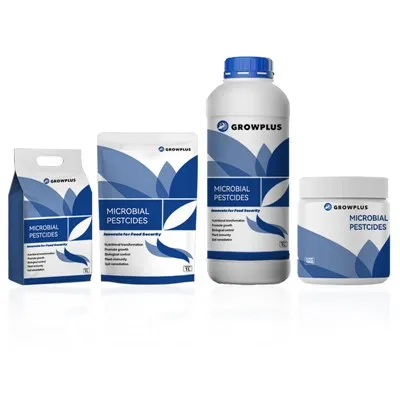
Metarhizium robertsii Biocontrol Agent delivers contact-kill control against root-damaging and foliar insect pests through fungal spore germination, cuticle penetration, and internal hyphal colonization.
Key Features of Metarhizium robertsii Biocontrol Agent
Dual Action Pathway: Kills insects via cuticular penetration while colonizing root rhizospheres for long-term plant protection.
High CFU Density: Standardized concentration options up to 1×10¹⁰ CFU/g ensure low dosage requirements per hectare.
Non-Target Safety: Zero toxicity to beneficial pollinators, earthworms, and soil microbes when applied as directed.
Resistance Management: Multi-site physical destruction mode prevents target insects from developing chemical resistance.
Low Residue Profile: Exempt from conventional chemical maximum residue limits for export crop compliance.
Active Microorganism
|
Microorganism Name |
Metarhizium robertsii |
|
Strain Identifier |
Strain MR-01 (Selected for high conidial yield and thermal tolerance) |
|
Classification |
Entomopathogenic Fungus (Hypocreales: Clavicipitaceae) |
|
Biological Form |
Viable conidiospores (asexual fungal spores) |
Mode of Action
Attachment and Germination: Conidia attach to the insect exoskeleton, germinating under favorable humidity above 70% RH.
Cuticle Penetration: Fungal hyphae produce appressoria and secrete extracellular enzymes including proteases, chitinases, and lipases to degrade the cuticle.
Internal Colonization: The fungus proliferates inside the hemolymph, producing destruxins that suppress insect immune responses.
Host Mortality: Death occurs within 3 to 7 days. Under humid conditions, white-to-green sporulation emerges on the cadaver to spread secondary infections.
Target Pests / Biological Targets
Subterranean Larvae: Wireworms (Agriotes species), White grubs (Phyllophaga species, Scarabaeidae), Corn rootworms (Diabrotica species), Root weevils.
Foliar and Soil Pests: Thrips (Frankliniella occidentalis), Termites, Locusts, Japanese beetles (Popillia japonica).
Crops & Applications
Cereal and Field Crops
Corn, wheat, potatoes, sugarcane, peanuts.
High-Value Horticulture
Tomatoes, peppers, berries, leafy greens, root vegetables.
Perennial Orchards and Plantations
Citrus, vineyards, tea plantations, oil palm nurseries.
Turf and Ornamentals
Golf courses, commercial sod farms, greenhouse flora.
Application Areas
Soil Drenching and Incorporation
Applied to control root-feeding grubs before or during sowing.
Foliar Spraying
Directed at canopy pests during early instar stages under high relative humidity.
Root Dipping and Seed Dressing
Protects seedlings against soil-borne pest complexes during transplanting.
Product Specifications
|
Parameter |
Technical Standard / Limit |
Test Method / Protocol |
|
Appearance |
Green to olive-brown fine powder |
Visual Inspection |
|
Spore Concentration |
High concentrate ≥ 1×10¹⁰ CFU/g / Standard ≥ 2×10⁸ CFU/g |
Hemocytometer / Plating Method |
|
Spore Viability (Germination Rate) |
≥ 90% after 24 hours incubation at 25°C |
Optical Microscopy |
|
Moisture Content |
≤ 5.0% |
Karl Fischer / Oven Drying |
|
Particle Size (Wettable Powder) |
Pass 325 mesh sieve ≥ 98% |
Wet Sieving Analysis |
|
PH Range (1% Suspension) |
5.5 to 7.5 |
Potentiometric Method |
|
Contaminant Microorganisms |
Non-detectable pathogenous bacteria (E. coli, Salmonella) |
Microbiological Culture |
|
Heavy Metals (Pb, As, Cd, Hg) |
Below 10 ppm total |
ICP-MS |
Formulation & Packaging
|
Formulation Types |
Technical Grade Powder, Wettable Powder, Oil Dispersion, Granular. |
|
Standard Packaging |
1 kg aluminum foil bags, 10 kg paper cartons, 25 kg fiber drums with double-layer polyethylene inner liners. |
|
Customization |
Private labeling, custom spore counts, and moisture-barrier bulk containers available. |
Storage & Shelf Life
|
Cold Storage (2°C to 8°C) |
18 months from manufacturing date in sealed original containers. |
|
Ambient Storage (15°C to 25°C) |
12 months in a cool, dry, well-ventilated area away from direct sunlight. |
|
Handling Precautions |
Keep containers tightly closed. Avoid opening packaging under ambient humidity above 60% before use. |
Quality & Technical Documentation
Certificate of Analysis provided for every production batch.
Safety Data Sheet compliant with global regulations.
Spore purity, viability assay, and heavy metal testing reports included with bulk shipments.
Technical Data Sheet and stability testing logs available upon inquiry.
Bulk Supply
Annual supply capacity up to 50 metric tons.
Scalable batch processing with batch traceability from fermentation tank to final seal.
Support for custom concentration adjustments and carrier blending based on recipient formulation equipment.
FAQ
Q: What is the difference between Metarhizium robertsii and Metarhizium anisopliae?
A: Metarhizium robertsii is a distinct species within the Metarhizium anisopliae clade, known for superior root-colonizing capability alongside its entomopathogenic action against soil pests.
Q: How should this product be tank-mixed with other agricultural inputs?
A: The powder can be mixed with most bio-fertilizers and non-fungicidal adjuvants. Avoid tank-mixing directly with synthetic chemical fungicides. Maintain a minimum 7-day interval between applying fungicides and Metarhizium robertsii.
Q: What environmental conditions optimize field efficacy?
A: Optimal activity occurs at temperatures between 20°C and 30°C with relative humidity above 70%. Applications during early morning, late afternoon, or overcast days prevent UV degradation of fungal spores.
Q: What is the minimum order quantity for bulk purchases?
A: Standard minimum order quantity is 100 kg for packaged wettable powder or 25 kg for technical grade concentrate. Custom packaging or custom concentration requests require evaluation based on production scheduling.
Hot Tags: metarhizium robertsii biocontrol agent, China metarhizium robertsii biocontrol agent manufacturers, suppliers, factory